


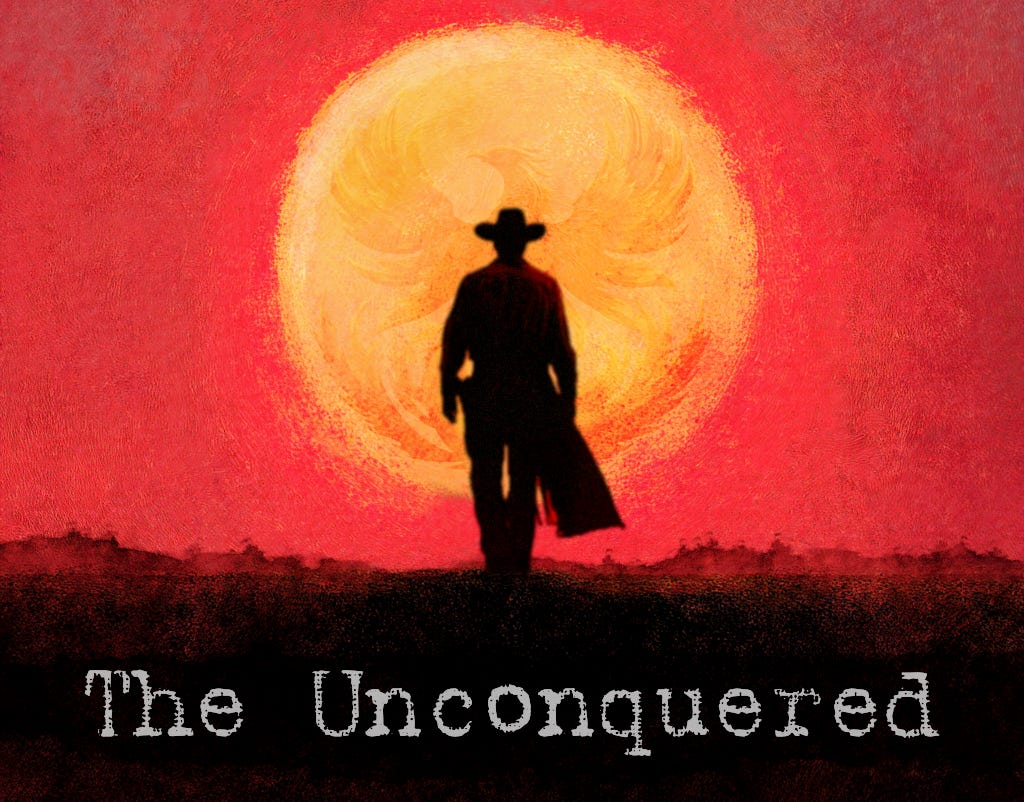
1
The sun was going down over the Texas Panhandle like a wounded animal.
It bled out across the horizon in long streaks of red and amber, and the flatland beneath it went dark from the ground up. Shadows pooled in the scrub and dry creek beds while the sky above still burned.
Three men on horseback moved against the fading light. They rode easy, and were in no particular hurry. They had seen the wagon fire from a distance and turned toward it with the appetite, patience and confidence of predators.
The Conestoga wagon was off the main trail by half a mile. Its canvas cover was patched in three places, and one wheel canted at the wrong angle.
The three riders’ eyes found the wagon bed before they found the family—a quick, professional sweep. Then the lead rider’s gaze settled on the rest of it. A man propped against the front wheel with his eyes half-closed and a darkness at his side that wasn’t shadow. A woman on the near side of the fire held a rifle like she knew how to use it.
A little girl watched from a small gap in the canvas. She did not make a sound.
The three riders came in slow and then slowly spread out—a maneuver practiced many times, so it appeared fluid and natural. They pulled up at the edge of the firelight. The one in front had a well-defined, angular jawline, and a smile with no warmth in it.
He started to say something, then stopped.
His horse shifted beneath him. The animal’s ears went back. Its nostrils flared once, reading something on the air. What it found there had no proper smell, and the sounds it made were subtle. The horse did not know what category to put it in, so it simply stood and waited.
The rider looked to his left. Then right. Nothing. The family was alone, and this was going to be easy.
Behind the riders, and in front of the setting sun, there was a shadow. It was man-shaped, but the outline shimmered in the evening heat.
The lead rider went for his gun.
The gun cleared leather, but the movement was never completed, because the rider was no longer on his horse.
It happened in the space between breaths—a displacement in the shadow behind them, a sound that started and did not finish, the middle horse shying hard to the right and finding itself suddenly, inexplicably lighter. The lead rider’s arm was up and his finger was on the trigger and then… there was nothing. The shadow was gone, and the rider had somehow gone with it.
The left rider made his decision without discussion. He turned his horse, put his heels in and did not look back.
The remaining rider sat alone in the firelight, eyes widening. He was a man who had ridden into bad country before, and was trying to calculate what kind of situation this was. He quickly found that the numbers didn’t work.
He looked at the woman. Her rifle came up, and their eyes met across the fire.
He lowered his gun, then holstered it with a shaking hand. Then he too turned and went.
The woman lowered her rifle and sighed to herself.
The fire crackled. A piece of wood shifted and sent up a brief column of sparks.
After a moment, from somewhere behind the wagon, there was the sound of someone working. A methodical sound—with the particular quality of a person who knows what they’re doing.
He came around the wagon and crouched by the broken wheel without announcing himself. He had seen the wheel from thirty yards out. A rock, half-buried in the trail rut, had caught it at exactly the wrong angle. It was bad luck, not bad driving.
He was a big man and moved quietly despite his size. His clothes were the color of the territory—trail dust had seen to that—and his hat was faded from time and weather. But the clothes and hat were not his. Not really. He had acquired them recently from a man who no longer needed them.
He looked like he had been walking for a long time, and a bath seemed to be a theoretical concept. But strangely, his smell did not match his appearance. In fact, he had no smell at all. The woman had noticed this with some relief, but did not comment on it.
He examined the axle, looked at the tools in the wagon bed, picked up what he needed, and went to work.
There was a box pushed to the rear of the bed, under a fold of canvas—lacquered wood, brass fittings, the kind of thing made for a shelf in a particular kind of house. He registered it and went back to work.
“I don’t know who ya are, mister. But thank ya,” the woman said.
“Just saw the wheel needed tending, is all.”
He continued with the manner of a man accustomed to doing things alone and in silence.
The man against the wheel opened his eyes. He listened to the stranger work with a confused, half-focused attention. His fever was getting worse. The wound at his side had been dressed, but not recently. Knife work, by the look of it, and from the front. He’d been facing whoever gave it to him.
He looked up and found the sun was just a thin band of dark red on the horizon.
The canvas gap above was still occupied. Two small and wide eyes, watching everything.
The axle took twenty minutes.
When he was done, the stranger stood and checked his work. Then he put the tools neatly back where he’d found them, which was a detail the woman noticed and would remember.
She approached him, grabbed his hand and placed some coins in it.
“We don’t have much,” she said looking up at him, “but you’re welcome to it.”
“Northeast,” he said, pocketing the coins. “Seven miles to water. Fourteen to a good doctor.” He looked at the man against the wheel. “Clearly he needs one.”
“Yes,” she said. “Yes he does.”
He nodded. He picked up his hat, which he had set on the wagon step while he worked, and put it back on.
“Mister?” It was the voice of a little girl.
He looked down at her.
“Carol-Anne Shaughnessy!” the woman said. “You leave that man alone.”
The little girl had come down from the wagon while he wasn’t looking. She was standing six feet away in the firelight, in a cotton dress and bare feet, looking up at him with a direct and unembarrassed gaze.
“Are you an angel?”
He looked at her for a moment.
“No,” he said. “Just really tough.” He paused. Something shifted in his face—not quite a smile, but somewhere in the neighborhood. “I guess you could say I have thick skin from being out here…”
He looked at the dark around them. The flatland going on in every direction until it hit the sky.
“…in God’s country,” he said.
The girl considered this with a furrowed brow. Then she nodded, apparently satisfied, and sat down in the dirt beside the fire to watch him go.
He walked away, and the dark took him.
Carol-Anne watched the place where he’d been for a long time after.
She would tell this story her whole life. To her children, and to their children, and to anyone else who would sit still long enough. She would tell it the same way every time, reinforcing the details as much to herself as to her audience. She wanted to get the details right, because they mattered—the shadow that was there before anyone saw it, the horse with a missing rider, the man who fixed a wheel without being asked and disappeared into the night. A man with no name.
Nobody ever quite believed her.
2
Two miles southwest, the signal pulled at him again. He walked toward it, through dry creek beds while dark grass and scrub hissed against his boots.
The stars were out in force. The Panhandle sky was enormous, and the Milky Way was a river of textured light bright enough to cast a faint shadow on open ground. He found it interesting that men in this place could actually navigate by it, even with no moonlight.
Coyotes called out in the distance and were answered by others.
He had been walking for nineteen days. He knew this the way he knew the temperature of the air and the precise bearing of the signal — not by counting, but because something inside him kept track without being asked. He had learned to accept the useful information whenever provided, and without thinking too much about the mechanism.
The signal was the same. It had no sound, but it did have a feeling. It was another sense to him, like hearing or smell. It was simply a fact about the world. A magnitude and direction, both of which seemed in constant flux as he walked. The way was always southwest. And he walked toward it because that was the only thing that made sense to him right now.
The Llano Estacado was the strangest ground he had crossed. Flat to the horizon in every direction and identical on all sides. Men often died out here, he understood, because there were no trees, no rise, no fixed point to orient against. He had no such problem, however. Something inside him knew north to within a fraction of a degree. He had no idea how it worked, but he understood how a man without that advantage might find the place uniquely hostile.
***
By morning, the grass was the color of old bone and the sky was a featureless dull gray. He crossed three dry creek beds before finding water. The stream was small but adequate for his needs.
He had a strong sense about what he was, but not who. That distinction had become very important. A clean line between two categories. The body he inhabited was not the body he started with. Something had been done to him—carefully, deliberately, by people who had done it many times to others. And the result was a thing that walked the Panhandle now, covering ground at a pace that would have killed a horse, drinking water when it was available and continuing anyway when it wasn’t.
He knew he was out of place. Not lost—just missing from where he was supposed to be. The evidence was consistent and the conclusion was not in dispute. Something had happened to him. He had arrived here without intention, and at the mercy of forces he did not comprehend. He had been attacked multiple times. Sometimes by wild animals, other times by armed men who seemed to be deliberately hunting him. He was confused by this, and a lot of other things—but he knew the signal was real and that it was getting louder. That, and the clothes he wore, were all he had. But they were sufficient.
The smell came without invitation, and on its own schedule. It was sharp, cold and metallic. And there was something underneath—a damp odor, like mildew. Then, he was assaulted with aromas. There seemed to be a hundred, and none he could name. He thought for a while, but abandoned it. He knew the information was there, he just couldn’t access it.
Then there was a sound attached to it: a rhythm. Mechanical, patient, repetitive.
And then…
Loading. Unloading. The weight and settle of cargo moving in an enclosed space. No daylight. No windows. No sky. No weather. Just pungent, damp and cold air.
He shook his head and there was a bright flash. Strange things appeared in the air—small symbols of varying colors. Then they were gone. Another flash. His vision went completely white, like he was staring at a blank wall.
He waited.
The whiteness faded but the symbols reappeared. They blinked a few times, then they too faded away.
This had happened to him before, but it seemed to be getting worse. It was happening more often, especially after some exertion on his part.
He walked.
Tascosa appeared in the early afternoon. It was a heat-shimmer at first, then resolved into actual structures—low buildings, a water tower and the skeletal geometry of several unfinished buildings against the sky. The town had received its name from the boggy creek that ran into the Canadian—a Mexican trader’s word for the mud that swallowed oxcarts at the crossing. He angled toward it without changing his pace.
What he needed was simple: information about the territory ahead, and maybe some work to help him buy food or a ride—preferably both. He had found that he was useful to people in ways that translated readily into compensation. He was large, strong and difficult to discourage. He knew these were valued qualities.
At the trading post, he paused at the door to look at the new sign out front.
Tascosa Traders
Est. 1869 - A. Zimmermann
Inside, a man behind the counter looked up. His eyes widened a bit—a common reaction from people when they saw his size. He ignored it.
“Help you?”
“Looking for work. Heading southwest.”
The man looked him over and his eyes narrowed. Whatever he was calculating, he reached the end of it quickly. “Freight wagon leaves tomorrow. Perdition Gulch, then on to canyon country. Guard work, mostly sitting. You look good for it. Lost the last man to a card dispute.” He said this without particular emotion, as a statement of fact.
Canyon country. The signal seemed to agree with that general direction.
He nodded.
“You’re not a gamblin’ man are ya. Drink a lot?”
“No.”
“Fine,’ said the man. “Then it’s a dollar a day, and you eat with the driver.”
“That’ll do,” he said. “Thank you, kindly.” It came out a little slow, but he was careful to bend the sounds to get the desired pronunciation. He was good at imitating sounds, and liked some of the regional accents.
He was eating alone that evening, at the far end of a long table, when the marshal came in.
The man moved through the room with a gait that was a bit ungainly. He looked for the boy who ran messages from the telegraph office. Finding him, he took a piece of folded paper, read it, then crushed it loosely in his hand.
He would have missed it entirely except that the marshal saw him and walked close.
“Hey there!” said the marshal, a little too loudly. He cleared his throat and then spoke softer. “New in town? What’s your business?”
There was a clear smell of liquor on his breath.
“Leaving town tomorrow, sheriff,” he said. “I won’t be any trouble.”
The marshal’s eyes went unfocused and he wobbled a bit on his feet. He caught himself, shook his head and said, “Good. Good! …uhhhh... ”
The marshal set the paper on the table and reached for something in his coat. The paper unfurled just enough that the message was face-up and legible.
He read it the way he read everything—completely, and in a glance.
...STRANGER STILL REMAINS... COYOTE SITE MIGHT BE COMPROMISED...
Above the text, where a sender’s mark would be, there was a symbol: A bird rising from and surrounded by a wreath of flame. He didn’t know why, but the image seemed out of place.
The marshal’s hand came down on the paper, crushed it tightly and jammed it into a front pocket. He looked around the room and found nothing else of interest. Then their eyes met, and his face became a mask of concern.
“He—hey! No peeking.”
The marshal went to a large black stove in the corner, clumsily fished out the telegram and dropped it in.
He ate methodically and watched the paper burn. He thought about the symbol, which he did not recognize, and the word COYOTE, which meant nothing to him. The word STRANGER… he had some thoughts about.
He went outside and stood in the dark for a while, looking southwest. The Milky Way arced overhead, dense and unhurried, indifferent to the particulars of any single night. He thought about the box in the wagon. He thought about the three riders—the way their eyes had gone to the wagon bed before they’d gone to the family. He thought about the wounded man against the wheel.
He wasn’t certain he’d made the right call.
The signal pulled again. Still southwest.
In the morning he went to find the freight wagon.
3
Prescott, Arizona smelled of fresh-cut pine and ambition. The town had gone up fast—buildings still pale from the saw, sawdust in the street ruts, the whole enterprise carrying the energy of a place that believed it was becoming something important. The street outside the gambling house would eventually be called Whiskey Row, though nobody had named it that yet. It was just the street with the establishments on it, and on a Tuesday evening it was doing reasonable business.
Creed sat at the Faro table with his back to the wall and played with the patience of a man who has spent decades mastering the craft.
He was not a drinking man. Not particularly. And he was not, strictly speaking, a gambling man either. He understood the odds well enough to know the house always collected in the end, and he had not survived as long as he had by making bets he couldn’t lose. But Faro was an honest game, more or less, and he liked the rhythm of it. The casebox, the layout, the slow turn of cards. It gave his hands something to do and left his mind free to wander without fear of mortal threats, which was the closest he got to freedom and relaxation.
He had been watching the man two seats to his left for the better part of an hour.
The man was good. Not good enough, but good. The copper tokens moved with practiced naturalness, and he’d positioned himself well. If Creed hadn’t spent the better part of four decades learning to read what men did with their hands when they thought nobody was watching, he might have missed it. He’d been keeping an eye on the man the same way he kept watch over the cards, quietly, waiting for the turn that would make it clear.
It came on the soda card. The man’s left hand moved under the table and came back with something that wasn’t there before. The bet he’d coppered flipped to straight, and the card came out and he reached for a pot that wasn’t rightfully his.
Creed’s hand came down on the man’s wrist.
Not hard. He had the hands for hard and rarely needed to use them. He held the man’s wrist with exactly the pressure required. Creed looked at the man with a raised eyebrow—the expression of someone who found a minor administrative error and intended to resolve it.
The man looked at the hand on his wrist. Then at Creed’s face. Then at the hand again.
The room had gone quiet in the way herd animals do when sensing danger nearby—they knew something was about to happen and everyone was preparing to dive for the floor or make a dash for the door.
“Take your hand off my—”
“Your chips,” Creed said. His voice was the voice of a man giving directions to a place he’s been many times. “All of them. Push them over here.”
A pause. “You can’t—”
Creed continued, as if the interruption hadn’t occurred. “You’re going to stand up, and you’re going to walk out that door. And then you’re gonna keep walking. Understand?”
The man looked around the table for support and found none. The other players faces had developed a glistening sheen of sweat.
The man pushed his chips across.
Creed released his wrist. He stacked the chips without counting them and returned his attention to the game. After a moment the man stood up. Creed did not watch him go. He heard the door, and then the fading sound of the man’s boot spurs as he walked away.
The dealer looked at Creed with terror and uncertainty in his eyes.
“Deal,” Creed said.
The telegram arrived soon after. A boy brought it through the door as if his life depended on it. He handed it off to Creed and ran out again like he was being chased.
Creed read the header, excused himself from the table without ceremony, and took it to the back room Hargrove’s people had arranged—a table, two chairs, a window facing west onto nothing in particular.
Holt was there, his journal open, writing in the small, precise hand he used for everything. He wrote the way he shot—economically, without wasted motion, hitting what he aimed at.
Creed read the telegram twice. Once for information, and once to be sure he’d read it correctly.
He set it on the table.
TO: RANGER CAPTAIN CREED
WORK AT SITE COYOTE BEHIND SCHEDULE STOP
SUGGEST INCREASED INCENTIVE IN FORM OF WHIP OR DEATH STOP
PERSON OF INTEREST THE STRANGER STILL REMAINS STOP
THREE CAPTURE TEAMS DEAD OR MISSING STOP
ACADIA PROJECT VERY DISPLEASED STOP
SUGGEST YOU HANDLE PERSONALLY STOP
COYOTE CANNOT BE COMPROMISED STOP
FROM: HARGROVE DEPT INTERIOR
Holt read it without picking it up. His expression didn’t change, which Creed had expected.
“Whip or death he says.”
“Aye-yup.”
“He means the laborers.”
Creed didn’t answer. He’d worked for men like Hargrove before—not this particular flavor, but the category. Men of considerable intelligence and considerable ambition and a very specific blindness to the difference between resource and person. It was a common enough blindness in Washington. It tended to produce efficient organizations run by people nobody wanted to be alone with in a small room.
He pulled the telegram back and folded it along its original creases.
Three teams. That was the part that had required the second reading.
“The Collier boys,” Holt said. He had closed his journal.
“Four brothers out of Texarkana,” said Creed. “Not Rangers. But every one a hard case.”
Holt eyed him with concern. “If he took down the Collier boys—” He didn’t finish.
Creed had known about the Colliers—the third team, last reported somewhere in the Texas Panhandle, moving to intercept. He had assumed the delay was terrain and distance, the usual variables.
Three teams dead or missing across five hundred miles of Texas. And the bearing unchanged the whole time. Southwest. Toward the canyon. Toward them.
“How long,” Creed said.
Holt was already consulting the journal. “If the last sighting is accurate, and his pace holds—” He made a small calculation. “Three weeks maybe.”
Three weeks. They had left the site several days ago on Hargrove’s blessing. A few days in Prescott could restore stamina and wellbeing that months of perimeter work in canyon country had a tendency to erode. That had been the word Hargrove used. Erode. Creed had found it an interesting word choice. He’d never met the man in person, but his telegrams invariably contained a word or two that seemed… out of place.
“We ride back tomorrow,” Creed said. It was not a question.
Holt closed his journal. “I’ll make sure the horses are ready.”
The room had gone dim when Creed became aware that it had a third person in it.
He did not startle. He had learned long ago that startling at Follows-Wind’s arrivals only encouraged him.
The man was near the door, dressed for the outside—trail clothes, dust on his boots and the tension of a man whose muscles never fully unknot indoors. His hair was long, worn in the way he’d learned to wear it from the people he’d lived among for eight years. It was not the way men wore it in Prescott. His face was a thing people had difficulty reading.
He looked at the telegram on the table without moving toward it.
"Thanks for coming," Creed said. "I know you’d… rather stay outside."
Follows-Wind’s eyes scanned the room with suspicion. “Too loud in here.”
Creed had known Follows-Wind for eleven years. He had never once heard him complain about cold or heat or distance or difficulty. He complained, occasionally, about noise. Towns were an assault on the senses, especially for those calibrated for quieter country.
“We head back tomorrow,” Creed said.
Follows-Wind looked at him. Something moved behind his eyes that Creed had learned to recognize as interest. He said nothing for a moment.
Then: “What does this stranger want?”
Creed had thought about this since the first report came in—the consistent bearing, the single-mindedness of movement through hard country, three teams and whatever had happened to them. It was not the behavior of a man running from something. It was the behavior of a man with somewhere to be.
“Unknown,” Creed said. “But he’s aiming for Coyote, and we can’t let him get past us.”
Follows-Wind nodded, then he left the room as quickly as he’d arrived.
Creed fed the telegram to the lamp. The paper caught, burned and was gone. The room smelled briefly of it, and then that was gone too.
Outside, the town carried on—piano slightly out of tune, the particular noise of men drinking away the silence of hard country. To the north, in the canyon, the site waited. Hargrove’s laborers were behind schedule, and three teams were unaccounted for somewhere in Texas.
And whoever or whatever had gone through those teams was still out there. And now it was his problem.
Tomorrow, Creed thought.
They had work to do.
4
He became aware of them around midday.
Not them exactly—but something. His hardware flagged it the way it flagged things it couldn’t fully resolve: a cluster of signals at the edge of his awareness, amber rather than the red he associated with an immediate threat. Not quite the geometry of men, not quite the geometry of animals. Something that moved the way the land moves when wind crosses it—present everywhere and nowhere specific, leaving no clean edge to read.
He didn’t slow his pace. He noted the motion and bearing of the interlopers and kept walking.
The freight wagon had left him at a crossroads two days back, the driver turning east toward Perdition Gulch. The settlements thinned. The trails went from rutted to faint to suggestions. The sky got bigger. He didn’t mind any of this.
The amber signals drifted at the edge of his awareness all afternoon. He tested them twice — pausing, letting his hardware adjust, get a cleaner reading. Whatever was out there knew how to integrate with the terrain. It moved when he wasn’t looking and stopped when he did, pacing him from a distance.
He thought about the men in Tascosa. He thought about the teams before them. He thought about the burnt paper and the firebird.
He made camp at dusk in a shallow draw that gave him rock at his back and sight lines in three directions. Small fire—enough for warmth, not enough to advertise. He ate a small bit of what he had, cleaned his hands on the dry grass, and let his systems run.
The amber signals were still there. Closer. Three of them, possibly four, distributed in a pattern that was not how animals distributed themselves. Cautionary. Watching.
He looked at the fire and waited.
They came out of the dark like smoke—first nothing, then presence, with no clear moment of transition between.
Three men. They moved to the edge of the firelight and stopped. Their movement was deliberate and unhurried, calibrated to give him time to see that their hands were empty. This was a vocabulary he understood. He stayed where he was and slowly raised his hands.
The one in front was older, with a face aged by weather and time. He stood with the economy of a man who had long since stopped spending energy on anything that didn’t matter. His eyes were doing something the other men’s eyes were not. They were reading him, trying to understand.
Behind him and to his left: a younger man, mid-twenties, watchful. Some Spanish in his face, none in his bearing. He had the quality of readiness that wasn’t aggression but was adjacent to it.
At the edge of the firelight, a third warrior held position in the outer dark. Not concealment. Distance. A respectful interval. He didn’t move.
The older man studied him for a long time without speaking. He let him.
Finally the older man spoke—to the younger one, not to him.
The younger man listened. Then he looked at him with the expression of someone about to attempt something difficult.
“He say—” A pause. “He say he know you. Not your face. Something else.”
“What does he know.”
More words. The younger man’s lips moved slightly as he worked through them.
“Medicine woman of our people. Eagle Doctor. She have vision. Many years past. Man who walks between worlds.” He thought about how to proceed. “He watch you since the wagon. Three men on horses.”
He looked at the fire.
“I’m not a ghost,” he said.
The translation went across. The older man’s expression didn’t change, but something in it shifted—not disagreement, but patience.
“He say—he know.” The younger man seemed to be choosing carefully. “He say—spirit is wrong word. Man from other place. Other time.”
A silence stretched on for several moments.
“Your medicine woman saw this?”
“Many years. She not doubt.” A pause. “Others doubt. Not her.”
“And he believed her.”
Something passed between the two men—brief, untranslatable.
“He believe her now.”
He reached into his pack and produced some dried beef and a heel of hardtack, setting them at the edge of the fire. The older man reached into his own pack and added dried meat. They ate without ceremony, and the fire burned between them, and after a time he understood that the meal itself was a negotiation and it was already complete.
The younger man’s name was Rios. He offered it with the slight formality of someone who didn’t often introduce themselves. The older man’s name came through him as Sitting Stone. The third warrior, still at the far edge of the light, was not introduced.
“I’m heading southwest,” he said. “Canyon country, Arizona territory. Do you know it?”
“Sitting Stone know it.” Rios glanced at the elder. “His grandfather’s people. He say—not go there.” A pause. “Three men go in. Long time past. Vision quest. Two come out—speaking strange. Unknown words. Could not stop.” He made a gesture, fingers moving outward from his mouth.
“It sounds like he’s describing the place I’m looking for.”
Rios looked at Sitting Stone. The elder listened to the translation without expression and then spoke at some length.
“He say—he not surprised. He say—we go with you. Help you.”
“Men are following me,” he said. “Have been since Texas. I’ve stopped them, but there will be more. You come with me, they’ll come for you too.” He looked at Sitting Stone directly. “Bounty Hunters. Men for hire. Working for men in Washington. They have a symbol I don’t… have a name for. A bird rising from flames.”
Rios began the translation.
Sitting Stone went still.
Not the patient stillness he’d held since entering the firelight—a different quality. He spoke, briefly. Rios listened and was quiet for a moment before he translated, and he had the clear impression that what came out was not everything that had been said.
“He say—he know these fire-bird men.” A pause. “He say he not afraid of them.”
He looked at the old man. Sitting Stone met his eyes with the calm of someone who has seen a lot of hardship and survived.
“Why not?”
Rios glanced at Sitting Stone again. The elder said one short thing.
“He say—he fight them before. Strong medicine, but just men.”
The fire crackled. An ember broke, floated upward and dimmed. Outside the draw the territory was enormous and indifferent and going on in every direction, and the signal was there as it always was, southwest, patient, pulling.
“You know this country better than I do,” he said.
Sitting Stone nodded.
The fire had burned down to coals before Sitting Stone spoke again. Through Rios, unhurried, the question came:
Where are you from?
He considered it. Not the question—the answer. He turned it over in his head.
“A ship,” he said, finally. “I think. Moving cargo.” Then he thought about how that might be translated and added, “big, heavy boxes.”
Rios translated. Sitting Stone listened and nodded slowly, his eyes on the coals. He said something quiet. Rios didn’t translate it, and he didn’t ask, but something in the old man’s face had settled.
He looked at the dark above the draw and thought.
Cargo. Enclosed. The cold that wasn’t quite cold and the close air and the rhythm of it, loading and unloading in the dark—
A name. It surfaced in his mind like a remembered dream.
GRIDIRON.
He reached for something else. An associated memory. But there was nothing. It was a door with no house around it, standing in the open, leading nowhere.
He let it go.
The fire ticked. The territory settled.
After a time Sitting Stone lay down and was still.
He did not sleep that night.
He lay on his back with the fire burning to coals and listened to the territory resting into itself—the small sounds of the dark, the wind in the dry grass, the distant calls of things that hunted by night. His hardware showed nothing. Whatever designation his systems used for threats had found nothing applicable to the three nearby men, and their symbols shifted to green.
After a time he became aware that his eyes had dark-adapted fully—the draw around him resolved out of blackness into shapes, the rock faces and the scrub and the pale grass moving in the faint wind.
He looked at the sky.
The stars were dense, hard and very close. Layered, textured, on a background of dark blue, going deeper than the eye could resolve. A meteor crossed the sky, bright enough to leave a trace.
He thought about Sitting Stone going still at the description of the bird symbol.
He thought about what Rios had chosen not to translate.
He thought about the signal, and the fragments that came sometimes without being asked—the cold air, the mechanical rhythm, the name at the edge of things.
He know you. Not your face. Something else.
He stared at the stars for a long time. They didn’t have answers. But they were consistent, and out here that was enough.
Southwest, the signal hummed.
He waited for the light.